

What Eras Would People Wear Animal Skins
Today'due south mail is all about animal print. It has been a staple in manner since the early 1930s. Nevertheless, before it became a mode statement, it was a sign of power. Kings and Queens endemic animal print rugs as a manner to show social status, and hunters believed that the brute prints gave them the power of that animal. For example, wearing the skin of a cheetah would give them the speed of that cheetah. Fifty-fifty though people have decided information technology doesn't give you ability, fashion lovers proceed to accept a need for animal print everything.
We began to see a rise in the demand for animal prints during the 1930s. 1 of the biggest movies at the fourth dimension,Tarzan the Apeman,came out in 1932. MGM's Johnny Weissmuller as "Tarzan", and Maureen O'Sullivan equally "Jane" wore creature print clothing. It caught the eye of the audience. For them, they saw it as audacious, exciting, and attractive. All of a sudden, manufacturers and designers came out with more and more beast print blouses, scarves, and coats than in previous decades.
Entering the 1940s, fur started to increase even more in demand after big names like Bettie Page, a model and i of the most famous pin-ups at the time, was featured inJungle Bettie.Page dressed up in a leopard print mini apparel creating an uproar for brute prints in the fashion globe. The 1940s were too the early stages of the women's move. History was mayhap repeating itself by giving power and strength, in a sense, to the women who wore it. It created a fierce and rather risque await for many and gave a era of independence.
 Then came the 1950s. A period of chic rather than risque. Christian Dior, a name still famous in 2018, opened up a whole new line all inspired by creature prints, more specifically leopard. His obsession of leopard came from Mitzah Bricard, his right hand adult female. She was born in Paris, France on November 12, 1900 equally Germaine Louise Neustadt. No one knew why she had changed her mind. Nevertheless, she had married and divorced twice. Later on meeting Christian
  Dior, she became his personal consultant in a way. He mentioned, "Bricard is i of those people, increasingly rare, who make elegance their sole reason for existence." Dior relied on her for tips to improve outfits by calculation accessories or taking pieces away. "From fourth dimension to time, Madame bricard emerges from her hatboxes, sails in magnificently, gives i definitely agin comment, condemns an unfortunate fabric with a expect or suddenly plumps for a daring color." Madame Bricards influence on Dior created a whole new era for creature print. Information technology now became a statement slice for every woman. Beautiful yet chic. Bricard wouldn't have wanted it whatsoever other fashion.
The hippie motility of the 1960s created a whole new world for beast impress. Prints were now exotic and "out there". Unlike the chic and sophisticated await of the 1950s, the new way was geared towards "The concept to be wild and free, like an 'like shooting fish in a barrel rider'."New colors were being introduced and limits were being tested.

With the 1970s came punk rock, and with punk rock came very interesting styles for animal print. Inspired by the pop hits of the 70s, animal print wa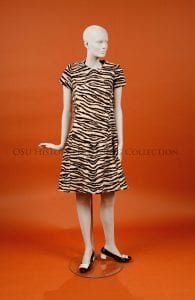 south taken back to the 1930s when it was used to seem more attractive and funky. Suddenly, animal impress was everywhere. Jumpsuits, undergarments, shoes, and bong bottoms were all infused with the brute impress style. Entering the 80s, at that place was an overwhelming amount of animal impress, and it even came with more prints than always earlier. In by decades, it was all about leopard and cheetah, specially in the days of Dior. However, zebra and snakeskin were now added. Full dresses, blouses, skirts, shoes, and more were making a statement. Today's way of fauna impress is well-rounded. It takes inspiration from all the previous decades in lodge to brand the print classy yet attractive.


SOURCES:
Foreman, Katya. "The Muse: Mitzah Bricard." Accessed on November xvi, 2018. Retrieved from https://wwd.com/business concern-news/retail/the-muse-mitzah-bricard-505061/
Walker, Alexis. "A Brief History of Fauna Prints." Accessed on November xi, 2018. Retrieved from https://www.nowthatslingerie.com/bradoctor/blog/blog-updates/a-brief-history-of-animal-prints/2011/04/28
Source: https://u.osu.edu/clotheslines/2018/11/16/the-history-behind-animal-prints/
Posted by: wolferemplume.blogspot.com
0 Response to "What Eras Would People Wear Animal Skins"
Post a Comment