

What Is The Setting Of Animal Farm
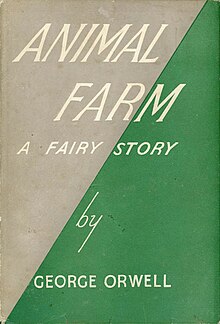 First edition cover | |
| Author | George Orwell |
|---|---|
| Original title | Creature Farm: A Fairy Story |
| Land | United Kingdom |
| Language | English language |
| Genre | Political satire |
| Published | 17 August 1945 (Secker and Warburg, London, England) |
| Media type | Print (difficult & paperback) |
| Pages | 112 (United kingdom paperback edition) |
| OCLC | 53163540 |
| Dewey Decimal | 823/.912 20 |
| LC Class | PR6029.R8 A63 2003b |
| Preceded by | Inside the Whale and Other Essays |
| Followed by | Nineteen Lxxx-Four |
Brute Farm is a satirical allegorical novella by George Orwell, first published in England on 17 August 1945.[1] [two] The volume tells the story of a group of subcontract animals who rebel against their human farmer, hoping to create a club where the animals can exist equal, free, and happy. Ultimately, the rebellion is betrayed, and the farm ends up in a state as bad equally it was earlier, nether the dictatorship of a grunter named Napoleon.
According to Orwell, the fable reflects events leading up to the Russian Revolution of 1917 and and then on into the Stalinist era of the Soviet Union.[3] [4] Orwell, a autonomous socialist,[5] was a critic of Joseph Stalin and hostile to Moscow-directed Stalinism, an mental attitude that was critically shaped by his experiences during the May Days conflicts between the POUM and Stalinist forces during the Spanish Civil War.[vi] [a] In a letter to Yvonne Davet, Orwell described Animate being Farm as a satirical tale against Stalin (" un conte satirique contre Staline "),[7] and in his essay "Why I Write" (1946), wrote that Animal Farm was the starting time book in which he tried, with full consciousness of what he was doing, "to fuse political purpose and creative purpose into one whole".[8]
The original championship was Brute Farm: A Fairy Story, but U.S. publishers dropped the subtitle when information technology was published in 1946, and only one of the translations during Orwell's lifetime, the Telugu version, kept it. Other titular variations include subtitles like "A Satire" and "A Contemporary Satire".[seven] Orwell suggested the title Union des républiques socialistes animales for the French translation, which abbreviates to URSA, the Latin discussion for "bear", a symbol of Russia. It also played on the French name of the Soviet Wedlock, Union des républiques socialistes soviétiques .[vii]
Orwell wrote the book between November 1943 and February 1944, when the Uk was in its wartime alliance with the Soviet Marriage confronting Nazi Federal republic of germany, and the British intelligentsia held Stalin in high esteem, a phenomenon Orwell hated.[b] The manuscript was initially rejected by a number of British and American publishers,[9] including i of Orwell's own, Victor Gollancz, which delayed its publication. Information technology became a great commercial success when information technology did appear partly because international relations were transformed as the wartime alliance gave way to the Cold State of war.[10]
Time magazine chose the volume equally one of the 100 best English-language novels (1923 to 2005);[eleven] it also featured at number 31 on the Modern Library List of Best 20th-Century Novels,[12] and number 46 on the BBC's The Big Read poll.[13] It won a Retrospective Hugo Laurels in 1996[14] and is included in the Nifty Books of the Western World option.[fifteen]
Plot summary [edit]
The poorly-run Estate Farm virtually Willingdon, England, is ripened for rebellion from its fauna populace by fail at the easily of the irresponsible and alcoholic farmer, Mr. Jones. One dark, the exalted boar, Old Major, holds a conference, at which he calls for the overthrow of humans and teaches the animals a revolutionary vocal called "Beasts of England". When Former Major dies, two immature pigs, Snowball and Napoleon, assume command and stage a defection, driving Mr. Jones off the subcontract and renaming the holding "Fauna Farm". They adopt the Seven Commandments of Animalism, the almost important of which is, "All animals are equal". The decree is painted in large letters on one side of the befouled. Snowball teaches the animals to read and write, while Napoleon educates young puppies on the principles of Animalism. To commemorate the start of Animal Farm, Snowball raises a green flag with a white hoof and horn. Food is plentiful, and the farm runs smoothly. The pigs drag themselves to positions of leadership and set up bated special food items, ostensibly for their personal health. Following an unsuccessful effort past Mr. Jones and his associates to retake the farm (afterward dubbed the "Battle of the Cowshed"), Snowball announces his plans to modernise the subcontract by building a windmill. Napoleon disputes this idea, and matters come to head, which culminate in Napoleon's dogs chasing Snowball away and Napoleon declaring himself supreme commander.
Napoleon enacts changes to the governance structure of the subcontract, replacing meetings with a committee of pigs who will run the farm. Through a young porker named Sus scrofa, Napoleon claims credit for the windmill idea, claiming that Snowball was only trying to win animals to his side. The animals work harder with the promise of easier lives with the windmill. When the animals find the windmill complanate subsequently a violent storm, Napoleon and Squealer persuade the animals that Snowball is trying to sabotage their project, and begin to purge the farm of animals defendant past Napoleon of consorting with his old rival. When some animals recall the Battle of the Cowshed, Napoleon (who was nowhere to exist constitute during the battle) gradually smears Snowball to the betoken of saying he is a collaborator of Mr. Jones, even dismissing the fact that Snowball was given an award of courage while falsely representing himself as the chief hero of the battle. "Beasts of England" is replaced with "Animal Subcontract", while an anthem glorifying Napoleon, who appears to be adopting the lifestyle of a man ("Comrade Napoleon"), is composed and sung. Napoleon then conducts a second purge, during which many animals who are alleged to be helping Snowball in plots are executed past Napoleon's dogs, which troubles the rest of the animals. Despite their hardships, the animals are easily placated by Napoleon'south retort that they are meliorate off than they were under Mr. Jones, also as by the sheep'south continual bleating of "4 legs expert, two legs bad".
Mr. Frederick, a neighbouring farmer, attacks the subcontract, using diggings powder to blow up the restored windmill. Although the animals win the boxing, they do so at great cost, as many, including Boxer the workhorse, are wounded. Although he recovers from this, Boxer eventually collapses while working on the windmill (existence almost 12 years old at that signal). He is taken away in a knacker's van, and a donkey called Benjamin alerts the animals of this, only Sus scrofa quickly waves off their alarm by persuading the animals that the van had been purchased from the knacker past an animal hospital and that the previous possessor's signboard had not been repainted. Squealer afterward reports Boxer's decease and honours him with a festival the following day. (Nonetheless, Napoleon had in fact engineered the sale of Boxer to the knacker, assuasive him and his inner circle to acquire money to buy whisky for themselves.)
Years laissez passer, the windmill is rebuilt and some other windmill is constructed, which makes the farm a practiced amount of income. However, the ideals that Snowball discussed, including stalls with electric lighting, heating, and running water, are forgotten, with Napoleon advocating that the happiest animals alive simple lives. Snowball has been forgotten, alongside Boxer, with "the exception of the few who knew him". Many of the animals who participated in the rebellion are dead or old. Mr. Jones is as well dead, saying he "died in an inebriates' dwelling house in another function of the country". The pigs kickoff to resemble humans, every bit they walk upright, carry whips, beverage alcohol, and wear wearing apparel. The Vii Commandments are abridged to merely 1 phrase: "All animals are equal, but some animals are more equal than others." The proverb "Four legs good, two legs bad" is similarly changed to "Iv legs good, two legs meliorate." Other changes include the Hoof and Horn flag beingness replaced with a manifestly greenish banner and Old Major's skull, which was previously put on display, being reburied.
Napoleon holds a dinner party for the pigs and local farmers, with whom he celebrates a new alliance. He abolishes the practice of the revolutionary traditions and restores the name "The Manor Subcontract". The men and pigs start playing cards, flattering and praising each other while cheating at the game. Both Napoleon and Mr. Pilkington, one of the farmers, play the Ace of Spades at the same time and both sides brainstorm fighting loudly over who cheated first. When the animals outside look at the pigs and men, they can no longer distinguish between the two.
Characters [edit]
Pigs [edit]
- Old Major – An aged prize Middle White boar provides the inspiration that fuels the rebellion. He is besides called Willingdon Beauty when showing. He is an allegorical combination of Karl Marx, ane of the creators of communism, and Vladimir Lenin, the communist leader of the Russian Revolution and the early Soviet nation, in that he draws up the principles of the revolution. His skull being put on revered public display recalls Lenin, whose embalmed body was left in indefinite placidity.[16] By the end of the book, the skull is reburied.
- Napoleon – "A big, rather fierce-looking Berkshire boar, the only Berkshire on the farm, not much of a talker, but with a reputation for getting his own style".[17] An allegory of Joseph Stalin,[sixteen] Napoleon is the leader of Brute Farm.
- Snowball – Napoleon's rival and original head of the farm afterward Jones' overthrow. His life parallels that of Leon Trotsky,[16] merely may besides combine elements from Lenin.[eighteen] [c]
- Squealer – A small, white, fat porker who serves as Napoleon'southward second-in-command and government minister of propaganda, holding a position like to that of Vyacheslav Molotov.[xvi]
- Minimus – A poetic hog who writes the second and third national anthems of Animal Farm later the singing of "Beasts of England" is banned. Literary theorist John Rodden compares him to the poet Vladimir Mayakovsky.[19]
- The piglets – Hinted to be the children of Napoleon and are the outset generation of animals subjugated to his idea of animal inequality.
- The young pigs – Four pigs who complain about Napoleon's takeover of the farm but are quickly silenced and afterward executed, the first animals killed in Napoleon's farm purge. Probably based on the Bully Purge of Grigory Zinoviev, Lev Kamenev, Nikolai Bukharin, and Alexei Rykov.
- Pinkeye – A minor hog who is mentioned but once; he is the taste tester that samples Napoleon's food to make sure information technology is non poisoned, in response to rumours about an bump-off endeavour on Napoleon.
Humans [edit]
- Mr. Jones – A heavy drinker who is the original owner of Estate Subcontract, a farm in disrepair with farmhands who oft loaf on the job. He is an allegory of Russian Tsar Nicholas Two,[20] who abdicated following the February Revolution of 1917 and was murdered, along with the rest of his family unit, by the Bolsheviks on 17 July 1918. The animals defection after Jones goes on a drinking rampage, returns hungover the post-obit day and neglects them completely. Jones is married, but his married woman plays no agile part in the book. She seems to alive with her husband'southward drunkenness, going to bed while he stays upwards drinking till late into the night. In her only other appearance, she hastily throws a few things into a travel handbag and flees when she sees that the animals are revolting. Towards the end of the volume, one of the farm sows wears her old Sunday dress.
- Mr. Frederick – The tough owner of Pinchfield Subcontract, a modest just well-kept neighbouring farm, who briefly enters into an brotherhood with Napoleon.[21] [22] [23] [24] Animal Farm shares land boundaries with Pinchfield on one side and Foxwood on some other, making Fauna Farm a "buffer zone" between the two bickering farmers. The animals of Animal Farm are terrified of Frederick, every bit rumours abound of him abusing his animals and entertaining himself with cockfighting. Napoleon enters into an alliance with Frederick in social club to sell surplus timber that Pilkington also sought, but is enraged to learn Frederick paid him in apocryphal money. Before long later the swindling, Frederick and his men invade Animal Farm, killing many animals and destroying the windmill. The cursory brotherhood and subsequent invasion may allude to the Molotov–Ribbentrop Pact and Operation Barbarossa.[23] [25] [26]
- Mr. Pilkington – The easy-going simply crafty and well-to-do owner of Foxwood Farm, a large neighbouring farm overgrown with weeds. Pilkington is wealthier than Frederick and owns more land, only his farm is in need of intendance as opposed to Frederick's smaller but more efficiently run farm. Although on bad terms with Frederick, Pilkington is also concerned about the animal revolution that deposed Jones and worried that this could likewise happen to him.
- Mr. Whymper – A man hired by Napoleon to human activity as the liaison between Animal Farm and human society. At beginning, he is used to larn necessities that cannot be produced on the farm, such as dog biscuits and methane series wax, but later he procures luxuries like alcohol for the pigs.
Equines [edit]
- Boxer – A loyal, kind, dedicated, extremely potent, hard-working, and respectable cart-horse, although quite naive and gullible.[27] Boxer does a big share of the physical labour on the farm. He is shown to agree the belief that "Napoleon is ever right." At 1 betoken, he had challenged Squealer'southward statement that Snowball was always against the welfare of the subcontract, earning him an set on from Napoleon's dogs. But Boxer's immense strength repels the attack, worrying the pigs that their authority tin can be challenged. Boxer has been compared to Alexey Stakhanov, a diligent and enthusiastic office model of the Stakhanovite motion.[28] He has been described as "faithful and strong";[29] he believes any problem can be solved if he works harder.[30] When Boxer is injured, Napoleon sells him to a local knacker to purchase himself whisky, and Squealer gives a moving account, falsifying Boxer's death.
- Mollie – A self-centred, self-indulgent, and vain young white mare who chop-chop leaves for another subcontract subsequently the revolution, in a manner similar to those who left Russian federation afterwards the fall of the Tsar.[31] She is only one time mentioned again.
- Clover – A gentle, caring mare, who shows concern especially for Boxer, who oftentimes pushes himself as well hard. Clover can read all the letters of the alphabet, but cannot "put words together". She seems to catch on to the sly tricks and schemes prepare by Napoleon and Squealer.
- Benjamin – A donkey, ane of the oldest, wisest animals on the farm, and 1 of the few who can read properly. He is sceptical, temperamental and cynical: his most frequent remark is, "Life volition become on as it has always gone on – that is, badly." The academic Morris Dickstein has suggested at that place is "a bear upon of Orwell himself in this creature's timeless scepticism"[32] and indeed, friends called Orwell "Donkey George", "afterward his grumbling ass Benjamin, in Animal Farm."[33]
Other animals [edit]
- Muriel – A wise onetime goat who is friends with all of the animals on the farm. Similarly to Benjamin, Muriel is one of the few animals on the farm who is not a pig only tin can read.
- The puppies – Offspring of Jessie and Bluebell, the puppies were taken abroad at birth past Napoleon and raised by him to serve as his powerful security forcefulness.
- Moses – The Raven, "Mr. Jones's especial pet, was a spy and a tale-bearer, but he was also a clever talker."[34] Initially post-obit Mrs. Jones into exile, he reappears several years later on and resumes his role of talking only not working. He regales Animal Farm's denizens with tales of a wondrous place across the clouds called "Sugarcandy Mountain, that happy country where we poor animals shall residuum forever from our labours!" Orwell portrays established religion as "the black raven of priestcraft – promising pie in the sky when you die, and faithfully serving whoever happens to be in power." His preaching to the animals heartens them, and Napoleon allows Moses to reside at the farm "with an assart of a gill of beer daily", akin to how Stalin brought back the Russian Orthodox Church during the Second World State of war.[32]
- The sheep – They are not given individual names or personalities. They evidence limited agreement of Animalism and the political temper of the farm, still nonetheless they are the voice of blind conformity[32] as they bleat their back up of Napoleon'southward ideals with jingles during his speeches and meetings with Snowball. Their abiding bleating of "four legs good, ii legs bad" was used equally a device to drown out any opposition or alternative views from Snowball, much as Stalin used hysterical crowds to drown out Trotsky.[35] Towards the end of the book, Squealer (the propagandist) trains the sheep to alter their slogan to "four legs practiced, 2 legs better", which they dutifully practise.
- The hens – Also unnamed, the hens are promised at the outset of the revolution that they volition become to keep their eggs, which are stolen from them under Mr. Jones. Nonetheless, their eggs are before long taken from them nether the premise of buying goods from outside Animal Farm. The hens are amidst the offset to rebel, albeit unsuccessfully, confronting Napoleon.
- The cows – Also unnamed, the cows are enticed into the revolution past promises that their milk volition not be stolen merely tin exist used to raise their own calves. Their milk is then stolen by the pigs, who learn to milk them. The milk is stirred into the pigs' mash every day, while the other animals are denied such luxuries.
- The cat – Unnamed and never seen to comport out any work, the cat is absent for long periods and is forgiven because her excuses are and then convincing and she "purred so affectionately that it was impossible not to believe in her good intentions."[36] She has no interest in the politics of the subcontract, and the but time she is recorded as having participated in an ballot, she is found to take actually "voted on both sides." [37]
- The ducks – Besides unnamed.
- The roosters – One arranges to wake Boxer early on, and a black one acts equally a trumpeter for Napoleon.
- The geese – Also unnamed. One gander commits suicide past eating nightshade berries.
Genre and style [edit]
George Orwell'due south Animal Farm is an example of a political satire that was intended to accept a "wider application", according to Orwell himself, in terms of its relevance.[38] Stylistically, the work shares many similarities with some of Orwell's other works, near notably Nineteen Lxxx-Four, equally both accept been considered works of Swiftian satire.[39] Furthermore, these two prominent works seem to suggest Orwell's dour view of the future for humanity; he seems to stress the potential/current threat of dystopias similar to those in Animal Farm and Nineteen Lxxx-4.[40] In these kinds of works, Orwell distinctly references the disarray and traumatic conditions of Europe following the Second World State of war.[41] Orwell's mode and writing philosophy equally a whole were very concerned with the pursuit of truth in writing.[42] Orwell was committed to communicating in a way that was straightforward, given the mode that he felt words were commonly used in politics to deceive and confuse.[42] For this reason, he is careful, in Animate being Farm, to make certain the narrator speaks in an unbiased and elementary mode.[42] The difference is seen in the way that the animals speak and interact, as the generally moral animals seem to speak their minds clearly, while the wicked animals on the farm, such every bit Napoleon, twist linguistic communication in such a manner that it meets their own insidious desires.[42] This mode reflects Orwell'due south close proximation to the issues facing Europe at the fourth dimension and his determination to comment critically on Stalin'south Soviet Russia.[42]
Groundwork [edit]
Origin and writing [edit]
George Orwell wrote the manuscript between November 1943 and February 1944[43] subsequently his experiences during the Spanish Civil State of war, which he described in Homage to Catalonia (1938). In the preface of a 1947 Ukrainian edition of Animal Farm, he explained how escaping the communist purges in Kingdom of spain taught him "how easily totalitarian propaganda can command the opinion of enlightened people in democratic countries."[44] This motivated Orwell to expose and strongly condemn what he saw equally the Stalinist abuse of the original socialist ideals.[45] Homage to Catalonia sold poorly; afterward seeing Arthur Koestler's all-time-selling, Darkness at Noon, most the Moscow Trials, Orwell decided that fiction was the best way to draw totalitarianism.[46]
Immediately prior to writing the book, Orwell had quit the BBC. He was also upset nigh a booklet for propagandists the Ministry of Information had put out. The booklet included instructions on how to quell ideological fears of the Soviet Union, such equally directions to merits that the Blood-red Terror was a figment of Nazi imagination.[47]
In the preface, Orwell described the source of the idea of setting the book on a subcontract:[45]
I saw a footling male child, perhaps 10 years erstwhile, driving a huge carthorse forth a narrow path, whipping it whenever information technology tried to turn. Information technology struck me that if only such animals became aware of their strength we should have no power over them, and that men exploit animals in much the same fashion as the rich exploit the proletariat.
In 1944, the manuscript was almost lost when a German V-one flying bomb destroyed his London habitation. Orwell spent hours sifting through the rubble to discover the pages intact.[48]
Publication [edit]
Publishing [edit]
Orwell initially encountered difficulty getting the manuscript published, largely due to fears that the volume might upset the alliance between United kingdom, the United States, and the Soviet Union. Four publishers refused to publish Animal Farm, yet ane had initially accepted the work, but declined it later on consulting the Ministry of Information.[49] [d] Somewhen, Secker and Warburg published the first edition in 1945.
During the 2d World State of war, it became clear to Orwell that anti-Soviet literature was not something which most major publishing houses would touch – including his regular publisher Gollancz. He besides submitted the manuscript to Faber and Faber, where the poet T. South. Eliot (who was a manager of the house) rejected it; Eliot wrote dorsum to Orwell praising the book'southward "adept writing" and "fundamental integrity", merely alleged that they would only accept it for publication if they had some sympathy for the viewpoint "which I take to be mostly Trotskyite". Eliot said he establish the view "not convincing", and contended that the pigs were made out to exist the best to run the farm; he posited that someone might argue "what was needed ... was non more than communism but more than public-spirited pigs".[50] Orwell let André Deutsch, who was working for Nicholson & Watson in 1944, read the typescript, and Deutsch was convinced that Nicholson & Watson would want to publish information technology; however, they did not, and "lectured Orwell on what they perceived to be errors in Creature Farm."[51] In his London Letter on 17 April 1944 for Partisan Review, Orwell wrote that it was "now next door to incommunicable to get anything overtly anti-Russian printed. Anti-Russian books do appear, but mostly from Catholic publishing firms and always from a religious or frankly reactionary angle."
The publisher Jonathan Greatcoat, who had initially accepted Brute Farm, afterward rejected the book later an official at the British Ministry of Information warned him off[52] – although the civil retainer who information technology is causeless gave the lodge was later found to be a Soviet spy.[53] Writing to Leonard Moore, a partner in the literary agency of Christy & Moore, publisher Jonathan Cape explained that the decision had been taken on the advice of a senior official in the Ministry of Information. Such flagrant anti-Soviet bias was unacceptable, and the option of pigs equally the dominant class was thought to be peculiarly offensive. It may reasonably be assumed that the "of import official" was a man named Peter Smollett, who was later unmasked equally a Soviet agent.[54] Orwell was suspicious of Smollett/Smolka, and he would be i of the names Orwell included in his list of Crypto-Communists and Swain-Travellers sent to the Data Enquiry Department in 1949. The publisher wrote to Orwell, saying:[52]
If the fable were addressed mostly to dictators and dictatorships at large then publication would be all right, but the fable does follow, as I run across at present, so completely the progress of the Russian Soviets and their two dictators [Lenin and Stalin], that it can apply only to Russia, to the exclusion of the other dictatorships.
Some other matter: it would exist less offensive if the predominant degree in the fable were non pigs. I retrieve the option of pigs every bit the ruling caste will no doubt give offence to many people, and particularly to anyone who is a bit touchy, equally undoubtedly the Russians are.
Frederic Warburg also faced pressures against publication, even from people in his own role and from his wife Pamela, who felt that information technology was not the moment for ingratitude towards Stalin and the Red Army,[55] which had played a major part in defeating Adolf Hitler. A Russian translation was printed in the paper Posev, and in giving permission for a Russian translation of Fauna Farm, Orwell refused in advance all royalties. A translation in Ukrainian, which was produced in Germany, was confiscated in large part past the American wartime authorities and handed over to the Soviet repatriation committee.[due east]
In October 1945, Orwell wrote to Frederic Warburg expressing interest in pursuing the possibility that the political cartoonist David Low might illustrate Animal Farm. Low had written a letter saying that he had had "a good fourth dimension with Creature Farm – an excellent bit of satire – information technology would illustrate perfectly." Nothing came of this, and a trial issue produced by Secker & Warburg in 1956 illustrated by John Driver was abandoned, but the Folio Society published an edition in 1984 illustrated past Quentin Blake and an edition illustrated past the cartoonist Ralph Steadman was published by Secker & Warburg in 1995 to celebrate the fiftieth anniversary of the first edition of Brute Farm.[56] [57]
Preface [edit]
Orwell originally wrote a preface complaining well-nigh British self-censorship and how the British people were suppressing criticism of the USSR, their World War II ally:
The sinister fact well-nigh literary censorship in England is that information technology is largely voluntary. ... Things are kept right out of the British press, not because the Authorities intervenes simply because of a full general tacit agreement that "it wouldn't do" to mention that particular fact.
Although the first edition allowed space for the preface, information technology was non included,[49] and equally of June 2009 nigh editions of the book have non included it.[58]
Secker and Warburg published the first edition of Animal Farm in 1945 without an introduction. However, the publisher had provided infinite for a preface in the author's proof composited from the manuscript. For reasons unknown, no preface was supplied, and the folio numbers had to be renumbered at the last infinitesimal.[49]
In 1972, Ian Angus found the original typescript titled "The Freedom of the Press", and Bernard Crick published it, together with his own introduction, in The Times Literary Supplement on fifteen September 1972 as "How the essay came to exist written".[49] Orwell's essay criticised British self-censorship by the press, specifically the suppression of unflattering descriptions of Stalin and the Soviet government.[49] The same essay also appeared in the Italian 1976 edition of Animal Farm with another introduction by Crick, claiming to be the first edition with the preface. Other publishers were still failing to publish it.[ clarification needed ]
Reception [edit]
Contemporary reviews of the piece of work were not universally positive. Writing in the American New Republic magazine, George Soule expressed his disappointment in the book, writing that it "puzzled and saddened me. Information technology seemed on the whole dull. The allegory turned out to be a creaking machine for saying in a clumsy way things that have been said meliorate direct." Soule believed that the animals were not consistent enough with their real-world inspirations, and said, "It seems to me that the failure of this book (commercially it is already bodacious of tremendous success) arises from the fact that the satire deals not with something the author has experienced, simply rather with stereotyped ideas about a country which he probably does non know very well".[59]
The Guardian on 24 August 1945 called Animal Farm "a delightfully humorous and caustic satire on the rule of the many by the few".[60] Tosco Fyvel, writing in Tribune on the aforementioned day, called the volume "a gentle satire on a certain State and on the illusions of an age which may already be behind us." Julian Symons responded, on 7 September, "Should nosotros not expect, in Tribune at least, acknowledgement of the fact that information technology is a satire not at all gentle upon a particular Land – Soviet Russian federation? It seems to me that a reviewer should have the courage to identify Napoleon with Stalin, and Snowball with Trotsky, and express an opinion favourable or unfavourable to the author, upon a political ground. In a hundred years fourth dimension perhaps, Animal Farm may be simply a fairy story; today it is a political satire with a good bargain of point." Animal Farm has been field of study to much comment in the decades since these early remarks.[61]
The CIA, from 1952 to 1957 in Operation Aedinosaur, sent millions of balloons carrying copies of the novel into Poland, Hungary and Czechoslovakia, whose air forces tried to shoot the balloons downwards.[46]
Time mag chose Animal Farm as ane of the 100 all-time English-language novels (1923 to 2005);[11] it too featured at number 31 on the Modern Library List of Best 20th-Century Novels.[12] It won a Retrospective Hugo Award in 1996 and is included in the Swell Books of the Western World pick.[15]
Popular reading in schools, Creature Farm was ranked the UK's favourite book from school in a 2016 poll.[62]
Fauna Farm has too faced an array of challenges in school settings around the US.[63] The following are examples of this controversy that has existed around Orwell'due south work:
- The John Birch Order in Wisconsin challenged the reading of Animal Farm in 1965 because of its reference to masses revolting.[63] [64]
- New York Land English Council's Committee on Defence Against Censorship constitute that in 1968, Animal Farm had been widely deemed a "trouble book".[63]
- A censorship survey conducted in DeKalb County, Georgia, relating to the years 1979–1982, revealed that many schools had attempted to limit access to Animal Farm due to its "political theories".[63]
- A superintendent in Bay Canton, Florida, banned Creature Subcontract at the middle school and high schoolhouse levels in 1987.[63]
- The Board quickly brought back the book, however, afterward receiving complaints of the ban as "unconstitutional".[63]
- Brute Farm was removed from the Stonington, Connecticut schoolhouse district curriculum in 2017.[65]
Animal Farm has likewise faced similar forms of resistance in other countries.[63] The ALA besides mentions the way that the book was prevented from being featured at the International Book Fair in Moscow, Russia, in 1977 and banned from schools in the United Arab Emirates for references to practices or actions that defy Arab or Islamic behavior, such as pigs or alcohol.[63]
In the same fashion, Animal Farm has likewise faced relatively recent issues in Mainland china. In 2018, the government made the conclusion to censor all online posts about or referring to Animate being Farm.[66] Still the book itself, every bit of 2019, remains sold in stores. Amy Hawkins and Jeffrey Wasserstrom of The Atlantic stated in 2019 that the book is widely available in Mainland China for several reasons: censors believe the full general public is unlikely to read a highbrow book, because the elites who do read books feel connected to the ruling party anyway, and because the Communist Party sees existence also aggressive in blocking cultural products equally a liability. The authors stated "It was—and remains—as piece of cake to buy 1984 and Brute Farm in Shenzhen or Shanghai as information technology is in London or Los Angeles."[67] An enhanced version of the volume, launched in Bharat in 2017, was widely praised for capturing the author's intent, past republishing the proposed preface of the Showtime Edition and the preface he wrote for the Ukrainian edition.[68]
Assay [edit]
Animalism [edit]
The pigs Snowball, Napoleon, and Squealer adapt Old Major'south ideas into "a complete system of thought", which they formally name Animalism, an allegoric reference to Communism, non to be confused with the philosophy Lust. Soon after, Napoleon and Grunter partake in activities associated with the humans (drinking booze, sleeping in beds, trading), which were explicitly prohibited by the Vii Commandments. Squealer is employed to modify the Seven Commandments to account for this humanisation, an allusion to the Soviet authorities's revising of history in order to exercise command of the people'due south beliefs about themselves and their society.[69]
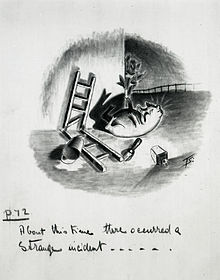
Pig sprawls at the foot of the finish wall of the big befouled where the Seven Commandments were written (ch. viii) – preliminary artwork for a 1950 strip cartoon by Norman Pett and Donald Freeman
The original commandments are:
- Whatever goes upon two legs is an enemy.
- Whatever goes upon four legs, or has wings, is a friend.
- No animal shall wear clothes.
- No animal shall sleep in a bed.
- No animal shall drink alcohol.
- No animal shall impale whatever other creature.
- All animals are equal.
These commandments are also distilled into the saying "Iv legs expert, 2 legs bad!" which is primarily used past the sheep on the farm, oftentimes to disrupt discussions and disagreements between animals on the nature of Animalism.
Later on, Napoleon and his pigs secretly revise some commandments to clear themselves of accusations of law-breaking. The inverse commandments are as follows, with the changes bolded:
- No fauna shall slumber in a bed with sheets.
- No animal shall drink booze to excess.
- No beast shall kill any other animal without crusade.
Somewhen, these are replaced with the maxims, "All animals are equal, merely some animals are more equal than others", and "Four legs expert, two legs improve" as the pigs become more human. This is an ironic twist to the original purpose of the Seven Commandments, which were supposed to keep club within Animal Farm by uniting the animals together against the humans and preventing animals from following the humans' evil habits. Through the revision of the commandments, Orwell demonstrates how just political dogma can be turned into malleable propaganda.[70]
Significance and allegory [edit]

The Horn and Hoof flag described in the book appears to be based on the hammer and sickle, the Communist symbol. By the end of the book when Napoleon takes full control, the Hoof and Horn is removed from the flag.
Orwell biographer Jeffrey Meyers has written, "virtually every particular has political significance in this allegory."[71] Orwell himself wrote in 1946, "Of grade I intended it primarily as a satire on the Russian revolution ... [and] that kind of revolution (violent conspiratorial revolution, led by unconsciously power-hungry people) tin can merely lead to a modify of masters [-] revolutions only consequence a radical comeback when the masses are alert."[72] In a preface for a 1947 Ukrainian edition, he stated, "for the by x years I have been convinced that the devastation of the Soviet myth was essential if we wanted a revival of the socialist movement. On my return from Spain [in 1937] I thought of exposing the Soviet myth in a story that could be easily understood by about anyone and which could exist easily translated into other languages."[73]
The revolt of the animals against Farmer Jones is Orwell's analogy with the October 1917 Bolshevik Revolution. The Battle of the Cowshed has been said to represent the allied invasion of Soviet Russian federation in 1918,[26] and the defeat of the White Russians in the Russian Ceremonious State of war.[25] The pigs' rise to preeminence mirrors the rise of a Stalinist bureaucracy in the USSR, simply as Napoleon's emergence as the subcontract's sole leader reflects Stalin's emergence.[27] The pigs' appropriation of milk and apples for their own utilize, "the turning point of the story" as Orwell termed it in a letter to Dwight Macdonald,[72] stands as an analogy for the crushing of the left-wing 1921 Kronstadt revolt against the Bolsheviks, [72] and the difficult efforts of the animals to build the windmill suggest the various Five Year Plans. The puppies controlled by Napoleon parallel the nurture of the secret law in the Stalinist structure, and the pigs' treatment of the other animals on the subcontract recalls the internal terror faced by the populace in the 1930s.[74] In affiliate seven, when the animals confess their non-real crimes and are killed, Orwell direct alludes to the purges, confessions and show trials of the late 1930s. These contributed to Orwell's confidence that the Bolshevik revolution had been corrupted and the Soviet organisation become rotten.[75]
Peter Edgerly Firchow and Peter Davison contend that the Battle of the Windmill, specifically referencing the Battle of Stalingrad and the Battle of Moscow, represents World War Two.[25] [26] During the battle, Orwell first wrote, "All the animals, including Napoleon" took cover. Orwell had the publisher change this to "All the animals except Napoleon" in recognition of Stalin'southward determination to remain in Moscow during the German advance.[76] Orwell requested the change after he met Józef Czapski in Paris in March 1945. Czapski, a survivor of the Katyn Massacre and an opponent of the Soviet regime, told Orwell, as Orwell wrote to Arthur Koestler, that it had been "the character [and] greatness of Stalin" that saved Russian federation from the German invasion.[f]
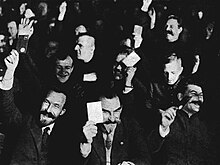
Front row (left to right): Rykov, Skrypnyk, and Stalin – 'When Snowball comes to the crucial points in his speeches he is drowned out by the sheep (Ch. V), just as in the party Congress in 1927 [above], at Stalin'due south instigation 'pleas for the opposition were drowned in the continual, hysterically intolerant uproar from the flooring'. (Isaac Deutscher[77])
Other connections that writers have suggested illustrate Orwell's telescoping of Russian history from 1917 to 1943[78] [g] include the wave of rebelliousness that ran through the countryside after the Rebellion, which stands for the bootless revolutions in Hungary and in Germany (Ch IV); the conflict between Napoleon and Snowball (Ch V), parallelling "the two rival and quasi-Messianic beliefs that seemed pitted against one some other: Trotskyism, with its faith in the revolutionary vocation of the proletariat of the Due west; and Stalinism with its glorification of Russia's socialist destiny";[79] Napoleon'due south dealings with Whymper and the Willingdon markets (Ch Half-dozen), paralleling the Treaty of Rapallo; and Frederick's forged banking concern notes, parallelling the Hitler-Stalin pact of August 1939, after which Frederick attacks Animal Farm without alarm and destroys the windmill.[23]
The book's close, with the pigs and men in a kind of rapprochement, reflected Orwell's view of the 1943 Tehran Conference[h] that seemed to display the establishment of "the all-time possible relations betwixt the USSR and the Due west" – but in reality were destined, as Orwell presciently predicted, to continue to unravel.[80] The disagreement between the allies and the start of the Common cold State of war is suggested when Napoleon and Pilkington, both suspicious, each "played an ace of spades simultaneously".[76]
Similarly, the music in the novel, starting with "Beasts of England" and the later anthems, parallels "The Internationale" and its adoption and repudiation by the Soviet authorities every bit the anthem of the USSR in the 1920s and 1930s.[81]
Adaptations [edit]
Stage productions [edit]
In 2021, the National Youth Theatre toured a phase version of Animal Farm.[82]
A solo version, adapted and performed by Guy Masterson, premièred at the Traverse Theatre Edinburgh in January 1995 and has toured worldwide since.[83] [84]
A theatrical version, with music past Richard Peaslee and lyrics by Adrian Mitchell, was staged at the National Theatre London on 25 April 1984, directed by Peter Hall. It toured nine cities in 1985.[85]
A new adaptation written and directed by Robert Icke, designed by Bunny Christie with puppetry designed and directed past Toby Olié opened at the Birmingham Repertory Theatre in January 2022 before touring the Britain.[86]
Films [edit]
Beast Farm has been adjusted to film twice. Both differ from the novel and have been accused of taking pregnant liberties, including sanitising some aspects.[87]
- Beast Farm (1954) is an animated film, in which Napoleon is somewhen overthrown in a second revolution. In 1974, East. Howard Chase revealed that he had been sent by the CIA'due south Psychological Warfare section to obtain the film rights from Orwell's widow, and the resulting 1954 animation was funded by the agency.[88]
- Animal Subcontract (1999) is a live-action TV version that shows Napoleon's regime collapsing in on itself, with the farm having new human owners, reflecting the plummet of Soviet communism.[89]
Andy Serkis is directing a film accommodation for Netflix, with Matt Reeves producing.[xc] Serkis began work on the motion picture after finishing directing duties for Venom: Let There Be Carnage.[91]
Radio dramatisations [edit]
A BBC radio version, produced by Rayner Heppenstall, was circulate in January 1947. Orwell listened to the production at his dwelling in Canonbury Square, London, with Hugh Gordon Porteous, amongst others. Orwell later wrote to Heppenstall that Porteous, "who had not read the book, grasped what was happening afterwards a few minutes."[92]
A further radio production, again using Orwell'due south own dramatisation of the book, was circulate in January 2013 on BBC Radio iv. Tamsin Greig narrated, and the cast included Nicky Henson equally Napoleon, Toby Jones equally the propagandist Squealer, and Ralph Ineson as Boxer.[93]
Comic strip [edit]

Strange Role copy of the first instalment of Norman Pett's Animal Subcontract comic strip. This example was deputed by the Data Research Department, a secret fly of the Strange Office which dealt with disinformation, pro-colonial, and anti-communist propaganda during the Cold State of war
In 1950, Norman Pett and his writing partner Don Freeman were secretly hired past the Data Research Department (IRD), a secret wing of the British Foreign Role, to adapt Brute Farm into a comic strip. This comic was not published in the U.K. but ran in Brazilian and Burmese newspapers.[94]
See also [edit]
- Information Enquiry Department
- Authoritarian personality
- History of Soviet Russia and the Soviet Union (1917–1927)
- History of the Soviet Union (1927–1953)
- Ideocracy
- New class
- Anthems in Beast Subcontract
- Animals, an album based on Brute Farm
Books [edit]
- Gulliver'due south Travels was a favourite volume of Orwell's. Swift reverses the role of horses and homo beings in the fourth book. Orwell brought to Animal Farm "a dose of Swiftian misanthropy, looking ahead to a time 'when the human race had finally been overthrown.'"[75]
- Bunt (Revolt), published in 1924, is a book by Polish Nobel laureate Władysław Reymont with a theme like to Animal Farm 's.
- White Acre vs. Black Acre, published in 1856 and written by William M. Burwell, is a satirical novel that features allegories for slavery in the United states of america[95] similar to Animal Farm 'due south portrayal of Soviet history.
- George Orwell's own Nineteen Eighty-Four, a classic dystopian novel about totalitarianism.
References [edit]
Explanatory notes [edit]
- ^ Orwell, writing in his review of Franz Borkenau'due south The Castilian Cockpit in Time and Tide, 31 July 1937, and "Spilling the Castilian Beans", New English language Weekly, 29 July 1937
- ^ Bradbury, Malcolm, Introduction
- ^ According to Christopher Hitchens, "the persons of Lenin and Trotsky are combined into 1 [i.e., Snowball], or, it might even be ... to say, at that place is no Lenin at all."[18]
- ^ Orwell 1976 p. 25 La libertà di stampa
- ^ Struve, Gleb. Telling the Russians, written for the Russian journal New Russian Current of air, reprinted in Remembering Orwell
- ^ A Note on the Text, Peter Davison, Animal Farm, Penguin edition 1989
- ^ In the Preface to Animal Farm Orwell noted, however, "although various episodes are taken from the actual history of the Russian Revolution, they are dealt with schematically and their chronological order is changed."
- ^ Preface to the Ukrainian edition of Animate being Farm, reprinted in Orwell:Collected Works, It Is What I Think
Citations [edit]
- ^ Bynum 2012.
- ^ 12 Things You 2015.
- ^ Gcse English Literature.
- ^ Meija 2002.
- ^ Orwell 2014, p. 23.
- ^ Bowker 2013, p. 235.
- ^ a b c Davison 2000.
- ^ Orwell 2014, p. ten.
- ^ Animal Farm: Sixty.
- ^ Dickstein 2007, p. 134.
- ^ a b Grossman & Lacayo 2005.
- ^ a b Modern Library 1998.
- ^ "BBC – The Big Read". BBC. April 2003. Retrieved 22 March 2020
- ^ The Hugo Awards 1996.
- ^ a b "Bang-up Books of the Western World as Complimentary eBooks". prodigalnomore.wordpress.com. 5 March 2019.
- ^ a b c d Rodden 1999, pp. 5ff.
- ^ Orwell 1979, p. fifteen, chapter Ii.
- ^ a b Hitchens 2008, pp. 186ff.
- ^ Rodden 1999, p. 11.
- ^ Fall of Mister.
- ^ Sparknotes " Literature.
- ^ Scheming Frederick how.
- ^ a b c Meyers 1975, p. 141.
- ^ Flower 2009.
- ^ a b c Firchow 2008, p. 102.
- ^ a b c Davison 1996, p. 161.
- ^ a b "Animal Farm". Films on Demand. 2014.
- ^ Rodden 1999, p. 12.
- ^ Sutherland 2005, pp. 17–xix.
- ^ Roper 1977, pp. 11–63.
- ^ "Brute Farm Characters". SparkNotes. 2007. Retrieved 7 December 2019.
- ^ a b c Dickstein 2007, p. 141.
- ^ Orwell 2006, p. 236.
- ^ Orwell 2009, p. 35.
- ^ Meyers 1975, p. 122.
- ^ Orwell 2009, p. 52.
- ^ Orwell 2009, p. 25.
- ^ Dwan, David (2012). "Orwell's Paradox: Equality in Animal Farm". ELH. 79 (3): 655–83. doi:10.1353/elh.2012.0025. ISSN 1080-6547. S2CID 143828269.
- ^ Crick, Bernard (31 December 1983). "The existent bulletin of '1984': Orwell's Classic Re-assessed". Financial Times.
- ^ rosariomario (10 April 2011). "George Orwell: Dystopian Novel – 1984 – Animal Farm". Spazio personale di mario aperto a tutti 24 ore su . Retrieved 26 November 2019.
- ^ Orwell, George. "Politics and the English language Language". Literary Column. 54: 20–26. ProQuest 210475382.
- ^ a b c d e KnowledgeNotes (1996). "Creature Subcontract". Signet Archetype. ProQuest 2137893954.
- ^ Orwell 2009.
- ^ Robertson, Ian (February 2019). "George Orwell'south Preface to the Ukrainian Edition of Animal Subcontract | The Orwell Foundation". www.orwellfoundation.com . Retrieved 6 March 2021.
- ^ a b Orwell 1947.
- ^ a b Dalrymple, William. "Novel explosives of the Cold War". The Spectator. Archived from the original on 26 August 2019. Alt URL
- ^ Overy 1997, p. 297.
- ^ Getzels, Rachael (12 September 2012). "Plaque unveiled where George Orwell'south Animal Farm almost went upward in flames". Retrieved xix October 2020.
- ^ a b c d e Liberty of the Press.
- ^ Eliot 1969.
- ^ Orwell 2013, p. 231.
- ^ a b Whitewashing of Stalin 2008.
- ^ Taylor 2003, p. 337.
- ^ Leab 2007, p. 3.
- ^ Fyvel 1982, p. 139.
- ^ Orwell 2001, p. 123.
- ^ Orwell 2015, pp. 313–xiv.
- ^ Robertson, Ian (February 2019). "george orwell – Does "Animal Farm" explicitly state anywhere in the text that it is in fact a political apologue?". Literature Stack Exchange . Retrieved 6 March 2021.
- ^ Soule 1946.
- ^ Books of twenty-four hours 1945.
- ^ Orwell 2015, p. 253.
- ^ "George Orwell's Creature Farm tops list of the nation's favourite books from schoolhouse". The Contained . Retrieved 15 December 2019.
- ^ a b c d e f g h admin (26 March 2013). "Banned & Challenged Classics". Advancement, Legislation & Issues . Retrieved 26 November 2019.
- ^ "Animal Farm past George Orwell". Banned Library . Retrieved fifteen December 2019.
- ^ Wojtas, Joe (2 February 2017). "'Animal Farm' non banned, school officials say; parents non satisfied". The 24-hour interval . Retrieved 21 February 2021.
- ^ Oppenheim, Maya (ane March 2018). "Communist china bans George Orwell's Animal Farm and alphabetic character 'Northward' from online posts every bit censors bolster Xi Jinping's plan to go on power". The Independent. ProQuest 2055087191.
- ^ Hawkins, Amy; Wasserstrom, Jeffrey (13 January 2019). "Why 1984 Isn't Banned in Communist china". The Atlantic . Retrieved 15 August 2020.
- ^ "Book Review: George Orwell's 'Animal Farm' Received Mixed Reviews from across the World, Enhanced Version at present Bachelor on Pirates". The Policy Times. 23 September 2020. Retrieved 23 September 2020.
- ^ Rodden 1999, pp. 48–49.
- ^ Carr 2010, pp. 78–79.
- ^ Meyers 1975, p. 249.
- ^ a b c Orwell 2013, p. 334.
- ^ Crick 2019, p. 450.
- ^ Leab 2007, pp. six–7.
- ^ a b Dickstein 2007, p. 135.
- ^ a b Meyers 1975, p. 142.
- ^ Meyers 1975, pp. 138, 311.
- ^ Meyers 1975, p. 135.
- ^ Meyers 1975, p. 138.
- ^ Leab 2007, p. 7.
- ^ Fay, Laurel East. (2000). Shostakovich : a life. Net Archive. New York : Oxford Academy Printing. ISBN978-0-19-513438-4.
- ^ Bentley, Charlotte. "National Youth Theatre heads to Shropshire stage 'sanctuary' for Animal Farm". www.shropshirestar.com . Retrieved 23 June 2021.
- ^ One homo Animal 2013.
- ^ Animate being Farm.
- ^ Orwell 2013, p. 341.
- ^ "Creature Farm phase accommodation bandage, tour dates and more revealed | WhatsOnStage". world wide web.whatsonstage.com . Retrieved 29 January 2022.
- ^ Robertson, Ian (December 2019). "author of fauna farm". www.restoration-marketplace.com . Retrieved 5 March 2021.
- ^ Chilton 2016.
- ^ Institute, Charlotte Lozier (December 2019). "Beast Farm (1954, 1999) | Charlotte Lozier Institute". Retrieved 5 March 2021.
- ^ "Netflix Picks Up Andy Serkis' Fauna Subcontract Motion picture Accommodation". ScreenRant. one August 2018.
- ^ "Andy Serkis Will Directly Brute Farm Next Later on Venom 2". ScreenRant. 28 September 2021.
- ^ Orwell 2013, p. 112.
- ^ Real George Orwell.
- ^ Norman Pett.
- ^ "Burwell's White Acre vs. Blackness Acre". Uncle Tom'due south Cabin & American Culture . Retrieved eighteen Oct 2020.
General sources [edit]
- "12 Things Yous May Non Know About Animal Subcontract". Metro. 17 August 2015. Retrieved 16 Baronial 2018.
- "1946 Retro-Hugo Awards". The Hugo Awards. 1996. Retrieved 23 February 2019.
- "Animal Farm: Lx Years On". History Today. Archived from the original on eight November 2017.
- "Creature Subcontract". Theatre Tours International (Archived re-create ed.). Archived from the original on 30 June 2009. Retrieved 2 Feb 2013.
- Bloom, Harold (2009). Bloom'due south Modern Disquisitional Interpretations: Brute Subcontract – New Edition (1st ed.). Infobase Publishing. ISBN978-1604135824. Archived from the original on 22 November 2016. Retrieved 13 May 2013.
- "Books of the day – Animal Farm". The Guardian. 24 Baronial 1945. Archived from the original on 30 July 2016. Retrieved 17 July 2016.
- Bowker, Gordon (2013). George Orwell. Little, Brown Book Group. ISBN978-1-4055-2805-iv.
- Bynum, Helen (2012). Spitting Blood: The History of Tuberculosis. Oxford University Press. p. xiii. ISBN978-0199542055.
- Carr, Craig Fifty. (2010). Orwell, Politics, and Power. Continuum International Publishing Group. ISBN978-1-4411-5854-iii . Retrieved 9 June 2012.
- Chilton, Martin (21 January 2016). "How the CIA brought Creature Farm to the screen". The Telegraph. Archived from the original on 26 Oct 2016. Retrieved 27 October 2016.
- Crick, Bernard (2019). George Orwell: A Life. Sutherland Firm Publishing. ISBN978-one-9994395-0-vii.
- Davison, P. (1996). George Orwell: A Literary Life. Palgrave Macmillan United kingdom. ISBN978-0-230-37140-8.
- Davison, Peter (2000). "George Orwell: Creature Farm: A Fairy Story: A Annotation on the Text". England: Penguin Books. Archived from the original on 12 December 2006.
- Dickstein, Morris (2007). "Beast Farm: History as fable". In John Rodden (ed.). The Cambridge Companion to George Orwell. Cambridge University Press. pp. 133–45. ISBN978-0-521-67507-ix.
- Eliot, Valery (six January 1969). "T.South. Eliot and Animal Farm: Reasons for Rejection". The Times. Britain. Archived from the original on xv October 2009. Retrieved 8 April 2009.
- "The Fall of Mister Jones and the Russian Revolution of 1917". Shmoop University. Archived from the original on ii December 2013. Retrieved thirteen May 2013.
- Firchow, Peter Edgerly (2008). Mod Utopian Fictions from H.K. Wells to Iris Murdoch. CUA Press. ISBN978-0-8132-1573-0.
- "GCSE English Literature – Creature Subcontract – historical context (pt 1/3)". BBC. Archived from the original on 3 January 2012.
- Giardina, Carolyn (xix October 2012). "Andy Serkis to Directly Accommodation of 'Animate being Farm'". hollywoodreporter.com. The Hollywood Reporter. Archived from the original on 13 Nov 2013. Retrieved 26 August 2013.
- Fyvel, Tosco R. (1982). George Orwell, a personal memoir . MacMillan. ISBN9780025420403.
- Grossman, Lev; Lacayo, Richard (sixteen October 2005). "All-Time 100 Novels". Time. Archived from the original on thirteen September 2008. Retrieved 31 Baronial 2008.
- Hitchens, Christopher (2008). Why Orwell Matters. Basic Books. ISBN978-0-7867-2589-ii.
- Leab, Daniel J. (2007). Orwell Subverted: The CIA and the Filming of Animal Subcontract. Penn State Press. ISBN978-0-271-02978-viii.
- Meija, Jay (26 Baronial 2002). "Animal Farm: A Creature Fable for Our Beastly Times". Literary Kicks . Retrieved xvi February 2019.
- Meyers, Jeffrey (1975). A Reader's Guide to George Orwell . Thames and Hudson. ISBN978-0-500-15016-0.
- "Norman Pett". lambiek.internet. Archived from the original on 17 December 2017. Retrieved 8 May 2018.
- "I homo Animate being Farm Show On the Way to Darwen". Lancashire Telegraph. 25 January 2013. Archived from the original on 6 January 2014.
- Orwell, George (1945). "The Freedom of the Press: Orwell's Proposed Preface to 'Beast Farm'". Archived from the original on 16 January 2013. Retrieved 22 February 2019.
- Orwell, George (1946). Animal Farm . New York: The New American Library. ISBN978-ane-4193-6524-9.
- Orwell, George (March 1947). "Preface to the Ukrainian Edition of Animal Farm". Archived from the original on 24 October 2005.
- Orwell, George (1979) [Start published by Martin Secker & Warburg 1945; published in Penguin Books 1951]. Animal Farm. England: Penguin Books. ISBN978-0-fourteen-000838-8.
- Orwell, George (2001). Smothered Nether Journalism 1946. Secker & Warburg. ISBN978-0-436-20556-9.
- Orwell, George (2006). Peter Hobley Davison (ed.). The Lost Orwell: Existence a Supplement to The Consummate Works of George Orwell. Timewell. ISBN978-1-85725-214-ix.
- Orwell, George (2009). Fauna Farm: A Fairy Story. HMH Books. ISBN978-0-547-37022-4.
- Orwell, George (2013). Peter Davison (ed.). George Orwell: A Life in Letters. West. W. Norton & Visitor. pp. 231–. ISBN978-0-87140-462-6.
- "The Real George Orwell, Creature Farm". BBC Radio 4. Archived from the original on 27 January 2013.
- Orwell, George (2014). Why I Write. Penguin Books Limited. ISBN978-0-xiv-198060-7.
- Orwell, George (2015). I Belong to the Left: 1945. Penguin Random House. ISBN978-1-84655-944-0.
- Overy, Richard (1997). Why the Allies Won. W.W. Norton. ISBN978-0-393-31619-3.
- Rodden, John (1999). Understanding Creature Farm: A Student Casebook to Issues, Sources, and Historical Documents. Greenwood Publishing Group. ISBN978-0-313-30201-5 . Retrieved 9 June 2012.
- Roper, D. (1977). "Viewpoint 2: The Boxer Mentality". Alter. ix (eleven): 11–63. doi:ten.1080/00091383.1977.10569271. JSTOR 40176954.
- "The Scheming Frederick and how Hitler Broke the Non-Aggression Pact". Shmoop Academy. Archived from the original on ii Dec 2013. Retrieved xiii May 2013.
- Soule, George (1946). "1946 Review of George Orwell'southward 'Animal Subcontract'". The New Republic. Archived from the original on 14 January 2017.
- "SparkNotes 'Literature Study Guides' "Animate being Farm" Chapter VIII". SparkNotes LLC. Archived from the original on 18 May 2013. Retrieved 13 May 2013.
- Sutherland, T. (2005). "Speaking My Heed: Orwell Farmed for Education". The English language Journal. 95 (ane): 17–19. doi:10.2307/30047391. JSTOR 30047391.
- Taylor, David John (2003). Orwell: The Life . H. Holt. ISBN978-0-8050-7473-4.
- "The whitewashing of Stalin". BBC News. eleven Nov 2008. Archived from the original on 12 November 2008.
- "Top 100 Best Novels". Modernistic Library. 1998. Retrieved 23 February 2019.
Further reading [edit]
- Bott, George (1968) [1958]. Selected Writings. London, Melbourne, Toronto, Singapore, Johannesburg, Hong Kong, Nairobi, Auckland, Ibadan: Heinemann Educational Books. ISBN978-0-435-13675-eight.
- Menchhofer, Robert W. (1990). Fauna Farm. Lorenz Educational Press. ISBN978-0787780616.
- O'Neill, Terry, Readings on Animal Farm (1998), Greenhaven Printing. ISBN 1565106512.
External links [edit]
- Beast Subcontract at Faded Folio (Canada)
- Animal Subcontract at Project Gutenberg Australia
- Animal Farm Book Notes from Literapedia
- Excerpts from Orwell'south letters to his agent apropos Beast Farm
- Literary Journal review
- Orwell's original preface to the book
- Animal Farm Revisited past John Molyneux, International Socialism, 44 (1989)
- Animal Farm at the British Library
- Creature Farm (1954)
Source: https://en.wikipedia.org/wiki/Animal_Farm
Posted by: wolferemplume.blogspot.com
0 Response to "What Is The Setting Of Animal Farm"
Post a Comment